Hotel and Hospitality Security in the DC Metro Area: What General Managers Need to Know

/in Armed Security/by Danny OsmanHotel and Hospitality Security in the DC Metro Area: What Every Property Manager Needs to Know
Hotels in the DC metro area face a distinct security challenge: they must simultaneously protect guests, staff, and assets while maintaining an environment that feels open, welcoming, and professional. Getting that balance wrong has real consequences.
Why Hotels Are a Unique Security Environment
Hotels operate 24 hours a day with a constantly rotating population of guests, staff, vendors, and visitors — many of whom have legitimate access to the property and many of whom do not. This creates a security challenge unlike almost any other commercial property type: access control must be both rigorous and invisible.
Guests expect a seamless, welcoming experience. They do not want to feel like they are entering a secured facility. At the same time, property managers and owners have a legal duty of care to protect those guests from reasonably foreseeable harm. Balancing these competing demands requires security personnel with specific hospitality training and a different operational mindset than officers deployed in industrial or commercial settings.
The DC metro area adds additional complexity. Hotels in this region serve a high proportion of government employees, lobbyists, foreign dignitaries, and high-profile corporate travelers. This population brings elevated threat profiles and, in some cases, specific federal security coordination requirements that not every security company is equipped to handle.
The Legal Duty of Care in Hotel Premises Liability
Virginia, Maryland, and DC each have distinct premises liability frameworks, but all three impose a meaningful duty of care on hotel operators. Courts have consistently held that hotels owe their guests a higher standard of care than many other commercial property types — largely because guests are in a uniquely vulnerable position, sleeping and living on the premises.
What this means practically: a hotel that experiences a foreseeable incident — a guest assault in a poorly lit parking garage, a room invasion enabled by a broken door lock, a theft from an inadequately secured common area — faces a much higher standard in premises liability litigation than a comparable incident at an office building.
The documentation standard matters as well. Courts look at whether the hotel maintained consistent security protocols, documented patrol activity and incident reports, responded appropriately to prior incidents, and had a trained security presence proportionate to the property’s size and risk profile.
Common Security Vulnerabilities in DC Metro Area Hotels
After auditing hotel security programs across Northern Virginia and the DC metro area, IronWatch Security has identified several vulnerability patterns that appear consistently across properties of different sizes and price points.
Parking structures are the most common high-risk area. They are often the least-supervised spaces on a hotel campus, accessible to non-guests, and are the site of a disproportionate share of thefts, assaults, and vehicle crimes. Many hotels rely entirely on camera systems in parking areas without any patrol coverage — a gap that determined bad actors routinely exploit.
Service corridors and back-of-house areas represent a second consistent vulnerability. These spaces — used by food delivery vendors, linen services, maintenance contractors, and staff — often have lower access control standards than guest-facing areas. An unsecured loading dock or an unmonitored service elevator is a potential entry point for unauthorized individuals.
Lobby and Common Area Security: Visible Without Being Intrusive
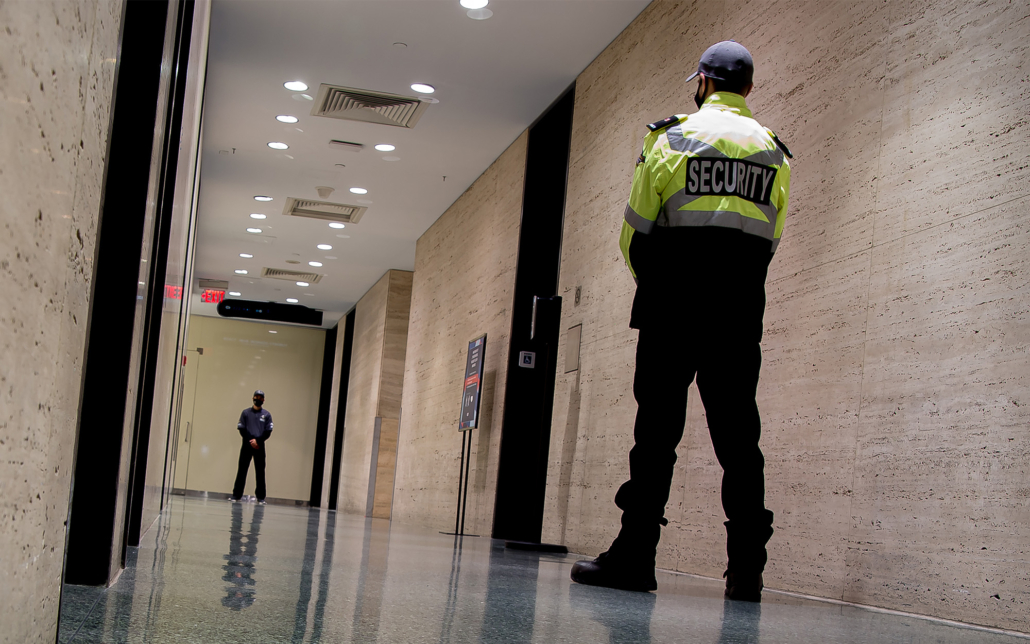
The lobby is the most visible point of your security program — and the one where the tension between hospitality and security is most acute. Security personnel in lobbies need to project calm authority without creating an atmosphere that makes guests feel surveilled or unwelcome.
This requires specific training. Officers who come from industrial or institutional security backgrounds often default to postures and communication styles that are appropriate for those environments but feel jarring in a hotel lobby. Hospitality security training emphasizes guest interaction skills, de-escalation before any confrontation occurs, and the ability to handle difficult situations with minimal visibility to other guests.
Lobby security also includes managing the persistent challenge of non-guests using hotel common areas — restaurants, bars, business centers, pool areas — without appropriate authorization. Trained officers handle these situations with discretion rather than confrontation, protecting the guest experience while maintaining access standards.
Guest Room Floor Security and After-Hours Protocols
Corridor and elevator security on guest room floors is often underinvested. Most incidents involving guest room access — from room invasions to theft from hallways — occur during overnight hours when staffing levels are lowest and supervision is minimal.
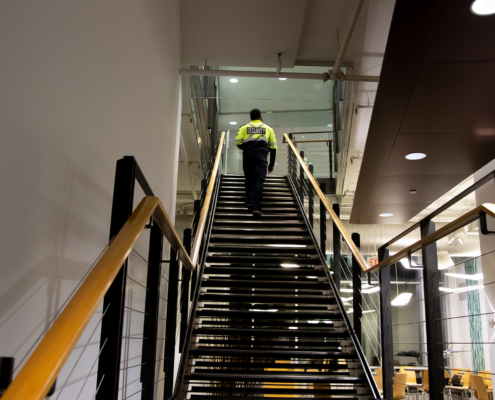
A formal after-hours security protocol should include scheduled patrol of all guest floor corridors, monitoring of stairwell access doors, and a clear escalation path for anything unusual. Officers conducting these patrols should be doing so on a documented schedule with GPS-tracked or electronically logged patrol points.
Key card access systems are a valuable layer of security but require active management. Access logs should be reviewed regularly for anomalies — multiple failed access attempts, access at unusual hours, or access from cards that should have been deactivated. A security company that integrates with your access control system can flag these patterns in near-real-time.
Event Security: Conferences, Weddings, and High-Profile Gatherings
Hotels that host conferences, political events, weddings, and other large gatherings face additional security demands that their regular program may not be designed to handle. Event security requires advance planning, additional staffing, specific crowd management protocols, and in some cases coordination with law enforcement or federal protective services.
The DC metro area’s concentration of government facilities, embassies, and political organizations means that a significant share of hotel events in this region involve principals with elevated security profiles. A hotel that does not have a protocol for coordinating security for high-profile guests or politically sensitive events is operating with a meaningful gap.
IronWatch Security provides event security staffing and planning services for DC metro area hotels, including advance site assessments, credential verification protocols, and integration with existing hotel security programs. We have experience working alongside federal protective details when required.
Staff Security Training: The Layer Most Hotels Neglect
Hotel security is not just the responsibility of uniformed security personnel. Every front desk associate, housekeeper, maintenance technician, and food service employee is a potential observer and first responder. Organizations that invest in staff security training significantly extend the effectiveness of their formal security program.
Basic staff security training should cover: how to recognize and report suspicious behavior, proper protocols for handling requests to access guest rooms, what to do when a guest reports a security concern, and how to summon security without creating alarm in the lobby or common areas.
Staff training is also a liability issue. A front desk associate who allows an unauthorized individual access to a guest floor because they were charming or persistent — without following proper verification protocols — creates exposure for the property regardless of how strong the formal security program is. Training and protocols together close that gap.
Integrating Technology With Human Security in Hotel Settings
Camera systems, access control platforms, and real-time monitoring tools significantly extend the reach of hotel security personnel. A well-integrated technology infrastructure means that officers can be deployed strategically based on monitored data rather than static patrol routes.
Modern hotel security programs increasingly use analytics-enabled camera systems that can identify anomalies — a person loitering in a stairwell for an extended period, unusual activity near a service entrance, crowd density changes in an event space — and alert security personnel before a situation escalates.
IronWatch Security works with hotel clients to integrate our officer coverage with their existing technology infrastructure. We are not a technology vendor — but we know how to make officer deployment smarter using the tools most hotels already have in place.
Selecting a Hotel Security Partner in the DC Metro Area
The right hotel security partner combines hospitality-specific training with deep regional knowledge of the DC metro area. They understand the legal frameworks in Virginia, Maryland, and DC. They have experience with the specific challenges of mixed-use hotel campuses, event security, and high-profile guest management.
They also understand that in a hotel context, security failures are reputational failures. An incident that ends up in a TripAdvisor review or a local news story does damage that extends well beyond the immediate legal and insurance consequences.
IronWatch Security has served DC metro area hospitality properties with professional armed and unarmed security services. We provide no-cost security assessments to help hotel operators identify gaps, optimize coverage, and build programs that protect guests while preserving the hospitality experience guests expect.
What to Expect from a Professional Hotel Security Assessment
A professional hotel security assessment covers all physical spaces — lobby, corridors, parking, service areas, event spaces, and back-of-house — along with a review of existing technology, staffing protocols, incident documentation practices, and staff training standards.
The assessment produces a written findings report and a prioritized set of recommendations. High-priority items are those that represent immediate legal exposure or foreseeable incident risk. Medium and low priority items represent optimization opportunities that improve program quality over time.
The goal is not to sell you the maximum amount of security coverage — it is to help you build a program that is appropriate for your property’s specific risk profile, defensible in litigation, and consistent with your guests’ experience expectations. That alignment is what a professional security partner produces.
Protect Your Guests, Your Staff, and Your Reputation
IronWatch Security provides professional hotel and hospitality security services across the DC metro area. Contact us for a free property assessment and consultation.
https://www.ironwatchsecurity.com/wp-content/uploads/2025/06/Low-angle-shot-of-security-guards-patrolling-inside-commercial-building.jpg
1250
2000
Danny Osman
/wp-content/uploads/2025/01/fulllogo_transparent-color.png
Danny Osman2026-03-29 10:00:002026-03-26 08:22:51Hotel and Hospitality Security in the DC Metro Area: What General Managers Need to Know
https://www.ironwatchsecurity.com/wp-content/uploads/2026/02/Northern-Virginia-crime-map-analysis.png
1024
1536
Danny Osman
/wp-content/uploads/2025/01/fulllogo_transparent-color.png
Danny Osman2026-03-28 10:00:002026-03-26 08:22:46DC Crime Is Down 37% — So Why Are Northern Virginia Businesses Investing More in Security?
https://www.ironwatchsecurity.com/wp-content/uploads/2025/03/ironwatch-security-guard-meeting.jpg
1780
1920
Danny Osman
/wp-content/uploads/2025/01/fulllogo_transparent-color.png
Danny Osman2026-03-27 10:00:002026-03-26 08:22:41How to Vet a Security Company in Virginia: Questions Every Client Should Ask
Access Control for Assisted Living Facilities: Balancing Security and Resident Freedom

Security as a Service in Arlington VA: Why Outsourcing Beats In-House Security Teams

When Unarmed Isn’t Enough: Armed Security for DC & Northern Virginia
Our Industries

This site uses cookies. By continuing to browse the site, you are agreeing to our use of cookies.
AcceptLearn moreCookie and Privacy Settings
We may request cookies to be set on your device. We use cookies to let us know when you visit our websites, how you interact with us, to enrich your user experience, and to customize your relationship with our website.
Click on the different category headings to find out more. You can also change some of your preferences. Note that blocking some types of cookies may impact your experience on our websites and the services we are able to offer.
These cookies are strictly necessary to provide you with services available through our website and to use some of its features.
Because these cookies are strictly necessary to deliver the website, refusing them will have impact how our site functions. You always can block or delete cookies by changing your browser settings and force blocking all cookies on this website. But this will always prompt you to accept/refuse cookies when revisiting our site.
We fully respect if you want to refuse cookies but to avoid asking you again and again kindly allow us to store a cookie for that. You are free to opt out any time or opt in for other cookies to get a better experience. If you refuse cookies we will remove all set cookies in our domain.
We provide you with a list of stored cookies on your computer in our domain so you can check what we stored. Due to security reasons we are not able to show or modify cookies from other domains. You can check these in your browser security settings.
We also use different external services like Google Webfonts, Google Maps, and external Video providers. Since these providers may collect personal data like your IP address we allow you to block them here. Please be aware that this might heavily reduce the functionality and appearance of our site. Changes will take effect once you reload the page.
Google Webfont Settings:
Google Map Settings:
Google reCaptcha Settings:
Vimeo and Youtube video embeds: