
Healthcare Facility Security in Northern Virginia: Protecting Patients, Staff, and Assets
/in Armed Security/by Danny OsmanHealthcare Facility Security in Northern Virginia: Protecting Patients, Staff, and Visitors
Healthcare settings present one of the most demanding security environments in any industry. Hospitals, clinics, and medical offices in Northern Virginia must protect vulnerable patients while maintaining an open, accessible environment for the people who need care.
Why Healthcare Security Is Unlike Any Other Commercial Setting
Healthcare facilities operate around the clock, serve populations that include individuals in acute distress, and must remain accessible to the public while protecting patients who are among the most vulnerable people in any community. The security requirements that follow from these conditions are more complex than those in almost any other commercial environment.
Violence against healthcare workers has been a growing concern nationally for more than a decade. The Bureau of Labor Statistics consistently reports that healthcare workers experience workplace violence at significantly higher rates than the general workforce. In emergency departments, psychiatric units, and substance use treatment settings, violent incidents are not rare exceptions — they are foreseeable operational risks that require active mitigation.
At the same time, healthcare security cannot feel like law enforcement. Patients and visitors who are frightened, grieving, in pain, or under the influence of substances need to be managed with a specific kind of professional competence that combines de-escalation skill with clear authority. Getting this balance wrong creates both safety failures and significant legal exposure.
The Legal Landscape for Healthcare Facility Security in Virginia
Virginia healthcare facilities face a layered legal framework governing their security obligations. The Joint Commission accreditation standards include environment of care requirements that address security management programs. CMS Conditions of Participation include patient rights provisions that have security implications. Virginia’s occupational safety framework requires employers to address foreseeable workplace violence risks.
Premises liability law adds another layer. A patient or visitor who is assaulted in a healthcare facility — in a parking garage, a waiting area, a hospital corridor, or a clinic — may have a viable negligence claim against the facility if reasonable security measures were not in place. Virginia courts apply a foreseeability standard that is particularly demanding in healthcare settings, where the patient population is predictably vulnerable.
Healthcare facilities that have experienced prior incidents face an even higher standard. Once a pattern of incidents is established, the argument that subsequent incidents were unforeseeable becomes much harder to sustain. Documented, consistent security programs are both a risk management tool and a litigation defense.
Emergency Department Security: The Highest-Risk Setting
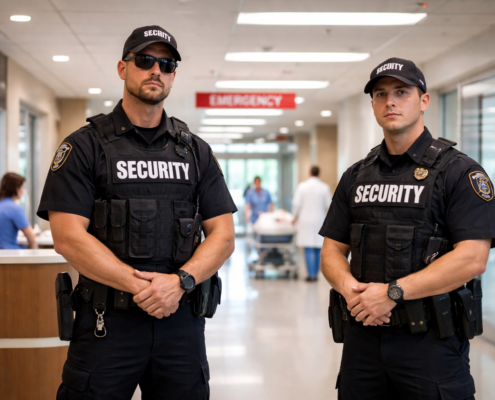
Emergency departments are the highest-risk security environment in most healthcare facilities. They operate 24 hours a day, serve individuals in crisis — including those with psychiatric emergencies, substance use issues, and acute pain — and typically cannot refuse entry to anyone presenting for care.
ED security requires officers with specific training in psychiatric de-escalation, substance use recognition, and the legal framework governing involuntary psychiatric holds in Virginia. An officer who defaults to law enforcement postures in an ED setting creates additional incidents rather than preventing them.
The physical layout of emergency departments creates specific vulnerabilities: triage waiting areas are often accessible to anyone who enters, treatment bays have limited sight lines, and the staff-to-patient ratios during surge periods mean that clinical personnel cannot monitor security conditions while managing medical emergencies. A dedicated security presence in the ED is not a luxury — it is an operational necessity.
Psychiatric Unit Security: Specialized Training Requirements
Psychiatric units require the most specialized healthcare security training. Officers working in inpatient psychiatric settings must understand involuntary commitment procedures, the legal framework governing patient rights in psychiatric settings, and the specific de-escalation approaches that are effective with individuals experiencing psychotic episodes, mania, severe depression, and other acute psychiatric conditions.
Virginia’s Temporary Detention Order and Emergency Custody Order processes create specific responsibilities for security personnel in facilities that hold individuals under these provisions. Officers must understand what they can and cannot do legally, how to coordinate with clinical staff, and how to document incidents in these sensitive settings.
IronWatch Security provides officers with healthcare-specific training that covers these requirements. Our officers who serve in psychiatric settings receive specialized preparation beyond standard DCJS requirements, including trauma-informed de-escalation techniques and healthcare-specific documentation protocols.
Parking Garage and Campus Perimeter Security
Healthcare facility parking structures are consistently among the most dangerous spaces on any hospital or clinic campus. They are visited by people who are distracted, stressed, and sometimes alone at odd hours. They have limited sight lines, poor natural surveillance, and access by both patients and general public.
A disproportionate share of violent incidents at healthcare facilities occur in parking structures rather than inside the building. This is true nationally and in the Northern Virginia market specifically. Facilities that concentrate their security investment inside the building while leaving parking structures minimally covered are making a significant error.
Effective parking security combines regular patrol coverage — on foot and/or by vehicle, documented and varied — with camera coverage designed to maximize sight lines. Emergency call stations, adequate lighting, and clear sightlines at entry and exit points are also important structural elements that good security programs address.
Visitor Management and Access Control in Healthcare Settings
Healthcare facilities face a persistent access control challenge: they must remain accessible to patients and visitors while protecting against individuals who represent a threat to staff or patients. This balance is particularly difficult in facilities that have issued restraining orders or no-trespass notices against specific individuals — a common situation in behavioral health settings.
A formal visitor management system — one that screens visitors against a trespass list, logs entry and exit times, and requires identification — is an important layer of protection that many smaller healthcare facilities lack. The implementation needs to be patient- and family-friendly, but the underlying controls are essential.
After-hours access control is a separate and equally important concern. Facilities that have multiple entry points open around the clock without active staffing at each point are creating exploitable vulnerabilities. A security program that consolidates after-hours access and provides dedicated monitoring at remaining entry points significantly reduces unauthorized access risk.
Staff Safety Programs: Beyond Security Officers
Clinical staff safety cannot be addressed by security officers alone. Healthcare organizations that reduce workplace violence most effectively do so through a combination of security personnel, environmental design improvements, staff training, clinical protocols that identify and manage at-risk patients, and leadership commitment to treating workplace safety as a non-negotiable priority.
Staff safety training should cover: how to recognize escalating behavior before it becomes violent, how to summon security without abandoning a patient, what to do when a patient or visitor becomes physically aggressive, and how to document incidents in a way that supports both clinical and security follow-up.
Buddy systems and check-in protocols for staff who work alone — in home health settings, in isolated clinical areas, during overnight shifts — are a low-cost intervention that significantly improves staff safety. These protocols need to be supported by security personnel who take rapid action when a check-in is missed.
Selecting a Healthcare Security Partner in Northern Virginia
The right healthcare security partner combines DCJS licensure with genuine healthcare-specific training and experience. Ask prospective providers whether their officers have completed specialized healthcare security training beyond state minimums. Ask for references from healthcare clients in Northern Virginia specifically.
Ask how they handle the specific situations that arise most frequently in healthcare settings: a patient who is threatening staff, a family member who will not leave after visiting hours, a psychiatric patient who attempts to leave before being cleared. The answers will reveal whether the company’s training matches the specific demands of your environment.
IronWatch Security has served healthcare facilities in Northern Virginia with professional security services. Our officers are selected and trained for the specific demands of healthcare environments, and we provide no-cost security assessments tailored to healthcare facility types.
Documentation and Reporting in Healthcare Settings
Security incident documentation in healthcare settings has implications that extend beyond standard commercial contexts. Incident reports may be relevant to Joint Commission surveys, CMS inspections, workers’ compensation claims, and premises liability litigation. The quality and completeness of your documentation record matters enormously.
A well-structured healthcare security documentation program includes: daily activity reports from all officer shifts, incident reports that capture all relevant details within hours of an event, trend reports that identify patterns across incidents over time, and periodic security program reviews that assess whether current coverage is meeting documented risks.
Documentation should be retained in a format and for a duration consistent with your facility’s risk management and legal hold requirements. Security companies that cannot produce organized historical documentation on request are not providing the full value of a professional security program — and are leaving your organization without the records you need when it matters most.
Protect Your Healthcare Facility, Your Staff, and Your Patients
IronWatch Security provides specialized healthcare security services across Northern Virginia and the DC metro area. Contact us for a free facility assessment tailored to healthcare environments.
https://www.ironwatchsecurity.com/wp-content/uploads/2025/03/event-security.jpg
1250
2000
Danny Osman
/wp-content/uploads/2025/01/fulllogo_transparent-color.png
Danny Osman2026-04-03 09:00:002026-03-25 08:00:49Event Security in the DC Metro Area: What Organizers Need to Know Before Hiring Guards
https://www.ironwatchsecurity.com/wp-content/uploads/2025/04/Professional-Armed-Protection-for-High-Risk-Environments.jpg
1250
2000
Danny Osman
/wp-content/uploads/2025/01/fulllogo_transparent-color.png
Danny Osman2026-04-02 10:00:002026-03-26 08:23:08Executive Protection in the DC Metro Area: When and Why You Need It
https://www.ironwatchsecurity.com/wp-content/uploads/2026/02/Hospital-Security.png
1024
1536
Danny Osman
/wp-content/uploads/2025/01/fulllogo_transparent-color.png
Danny Osman2026-04-01 10:00:002026-03-26 08:23:04Healthcare Facility Security in Northern Virginia: Protecting Patients, Staff, and Assets
https://www.ironwatchsecurity.com/wp-content/uploads/2025/08/Security-guard-walking-with-firearm-in-holster.jpg
1250
2000
Danny Osman
/wp-content/uploads/2025/01/fulllogo_transparent-color.png
Danny Osman2026-03-31 10:00:002026-03-26 08:22:59What the National Guard Presence in DC Means for Northern Virginia Private Security

https://www.ironwatchsecurity.com/wp-content/uploads/2025/09/Server-room-data-center.jpg
1250
2000
Danny Osman
/wp-content/uploads/2025/01/fulllogo_transparent-color.png
Danny Osman2026-03-30 10:00:002026-03-26 08:22:56How AI Is Changing the Security Guard Industry in 2026 — And What It Means for Northern Virginia Businesses
https://www.ironwatchsecurity.com/wp-content/uploads/2025/06/Low-angle-shot-of-security-guards-patrolling-inside-commercial-building.jpg
1250
2000
Danny Osman
/wp-content/uploads/2025/01/fulllogo_transparent-color.png
Danny Osman2026-03-29 10:00:002026-03-26 08:22:51Hotel and Hospitality Security in the DC Metro Area: What General Managers Need to KnowOur Industries

Executive Protection in the DC Metro Area: When and Why You Need ItThis site uses cookies. By continuing to browse the site, you are agreeing to our use of cookies.
AcceptLearn moreCookie and Privacy Settings
We may request cookies to be set on your device. We use cookies to let us know when you visit our websites, how you interact with us, to enrich your user experience, and to customize your relationship with our website.
Click on the different category headings to find out more. You can also change some of your preferences. Note that blocking some types of cookies may impact your experience on our websites and the services we are able to offer.
These cookies are strictly necessary to provide you with services available through our website and to use some of its features.
Because these cookies are strictly necessary to deliver the website, refusing them will have impact how our site functions. You always can block or delete cookies by changing your browser settings and force blocking all cookies on this website. But this will always prompt you to accept/refuse cookies when revisiting our site.
We fully respect if you want to refuse cookies but to avoid asking you again and again kindly allow us to store a cookie for that. You are free to opt out any time or opt in for other cookies to get a better experience. If you refuse cookies we will remove all set cookies in our domain.
We provide you with a list of stored cookies on your computer in our domain so you can check what we stored. Due to security reasons we are not able to show or modify cookies from other domains. You can check these in your browser security settings.
We also use different external services like Google Webfonts, Google Maps, and external Video providers. Since these providers may collect personal data like your IP address we allow you to block them here. Please be aware that this might heavily reduce the functionality and appearance of our site. Changes will take effect once you reload the page.
Google Webfont Settings:
Google Map Settings:
Google reCaptcha Settings:
Vimeo and Youtube video embeds:


